
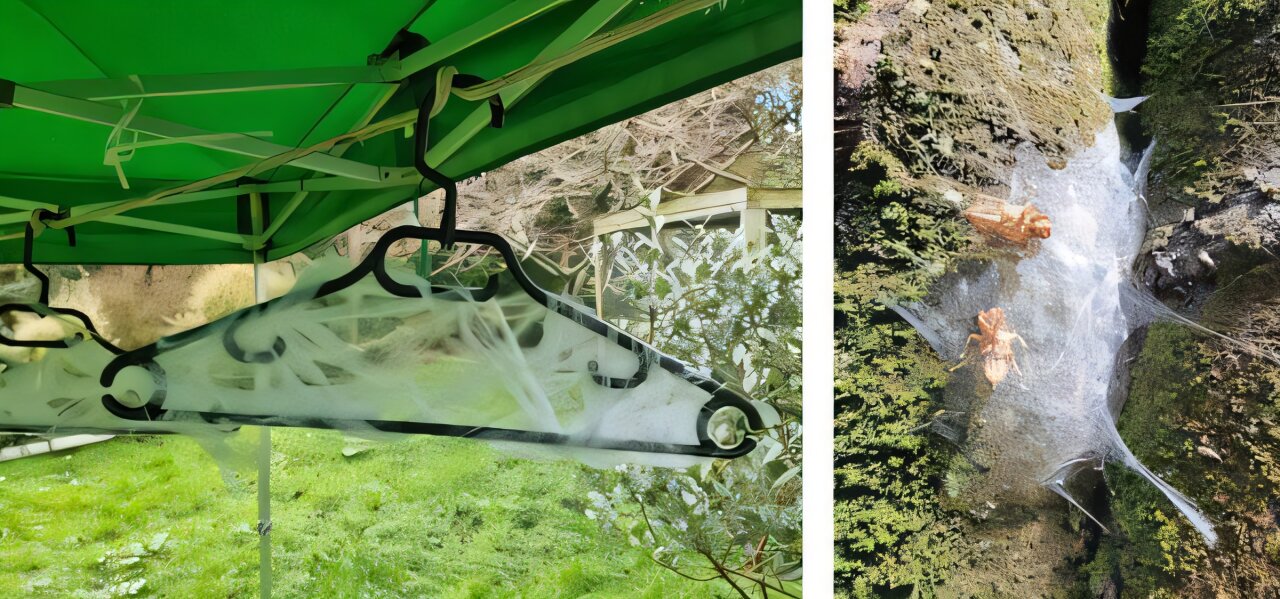

Artificial spider webs are just as good as natural ones at capturing DNA from the air. Credits: Angela (Ang) McGaughran, Manpreet K Dhami, CC BY-ND.
Global crisis of reduction of biological diversity poses a challenge to our current ability to monitor changes in ecosystems.
DNA of the environment, or eDNAhas become a popular method. This involves taking a sample from the environment and extracting DNA to document the species that are (or were recently) present.
Just as barcodes are matched to the price of an item in a supermarket, eDNA data is matched to the corresponding identification record in a reference database.
But most eDNA sampling takes place in water, passing liters of liquid through a filter that retains DNA fragments for analysis. This method works very well for fresh water and marine speciesbut less so on land.
Enter DNA in the air, or airDNA, an an emerging method not yet optimized for widespread commercial application, but with great promise for capturing terrestrial biodiversity signals.
Researchers investigated the question of whether natural spider webs could be used to collect DNAbut our research goes one step further.
Inspired by a little Halloween decoration, we designed artificial spider webs to see if they were as good as the real thing at catching DNA in the air. Our data show that artificial spider webs perform similarly to real spider webs in detecting land-dwelling species.
History of DNA capture
eDNA is used to monitor changes in biodiversity, discover new species, and assess the success of restoration or eradication projects. It is easy to use, inexpensive and non-invasive, and is now being used by citizen scientists, community groups and mana whenua.
But species that live mainly on land – mammals, birds, bats, reptiles, insects – are less easily detected by this method.
One of first studies to demonstrate the potential of methods for DNA analysis in air vacuumed air in a zoological park in Huntingdonshire (United Kingdom). He collected DNA from 17 terrestrial species, including black and white lemurs, howler monkeyssloths and tigers, as well as their food items and other mammals and birds.
This prompted further research, including the use of cheaper, passive air DNA collection methods that rely on air deposition on inert biofilters. Recent study investigated whether natural spider webs could provide a new way to capture traces of vertebrate DNA from the environment.
This work caused excitement among researchers, who immediately saw the potential of spider webs to provide aerosol DNA in addition to DNA obtained from the spiders themselves and their recent prey.
We shared the general excitement with our colleagues, but we couldn’t help but wonder about the possible negative effects of widespread use of this method on spiders. The spiders are already on the receiving end of bad pressbut they have an important role in the ecosystem as natural pest and disease control agents. They eat around 800 million tons of insects annually worldwide.
The use of natural nets is also less robust, as their size and shape and how long and where they are deployed are left to chance.
How do artificial networks work?
Compared to aquatic eDNA methods, both types of spider webs in our study revealed a clear signature of terrestrial communities. But they were also good biofilters for trapping fungi, probably by capturing floating fungal spores.
The ecosystem picture drawn from both types of networks compared to aquatic eDNA also shows that these methods are likely to be complementary, capturing a more complete catalog of species in terrestrial and aquatic ecosystems.
This is great news: artificial spider webs are easy and cheap to construct and provide better control over the location, frequency, and duration of DNA collection—all at a lower cost to nature.
Where to from here? Further refinements are on the way. Unsolved questions include how many artificial spider webs we need to capture enough biodiversity, whether these webs will perform better or worse in windy or wet conditions, and whether materials other than Halloween decorations can provide an even better artificial web.
As we continue to explore such questions, perhaps nature’s weavers will provide further inspiration to help us design even better biomechanical solutions for measuring biodiversity.
Enabled
Conversation
This article was republished from Conversation under Creative Commons license. Read it original article.
Quote: Spiders inspire biologists to create artificial webs to capture airborne DNA to monitor biodiversity (2025, November 1) Retrieved November 2, 2025, from https://phys.org/news/2025-10-spiders-biologists-artificial-webs-capture.html
This document is subject to copyright. Except for fair dealing purposes for private study or research, no part may be reproduced without written permission. The content is provided for informational purposes only.
Source link
Ecology Molecular & Computational biology , Science,Physics news,Scientific news,Technology news,Physics,Materials,Nanotech,Technology,Science , #Spiders #inspire #biologists #create #artificial #webs #capture #airborne #DNA #monitor #biodiversity, #Spiders #inspire #biologists #create #artificial #webs #capture #airborne #DNA #monitor #biodiversity, 1762063876, spiders-inspire-biologists-to-create-artificial-webs-to-capture-airborne-dna-to-monitor-biodiversity