
Summer gave us a strong contender for anime of the year, plus some exceptional comedies and daringly out-there concepts.
How did we choose our recs?
Participating staff members can nominate up to three titles and can also co-sign other nominated shows. Rather than categorizing titles as “feminist-friendly” or “problematic,” they are simply listed in alphabetical order with relevant content warnings; doing otherwise ran the risk of folks seeing these staff recommendations as rubber stamps of unilateral “Feminist Approval,” which is something we try our hardest to avoid here.
The titles below are organized alphabetically. As a reminder, ongoing shows are NOT eligible for these lists. We’d rather wait until the series (or season) has finished up before recommending it to others, that way we can give you a more complete picture. This means we also leave out any unfinished split-cour shows, which we define as shows that air a second season less than a year after the first (often defined by announcing a sequel with an already-secured upcoming air date).
We also elected to leave There’s No Freaking Way I’ll Be Your Lover, Unless…. off the list; while its second season/film doesn’t have an announced air date, its current ending feels incomplete on its own, and thus we decided to revisit the series following its proper conclusion.
Ruri Rocks was another title we enjoyed as a celebration of girls in STEM despite the early episode fan service, but it didn’t have a recommendation completed prior to publication.
Here’s what the team thought—let us know your picks in the comments!

Recommended by: Alex, Dee
What’s it about? 11-year-old Anne Shirley has spent her life bouncing between caretakers and the orphan asylum, but her fortunes seem to have changed when she’s called to the beautiful Prince Edward Island to assist aging siblings Matthew and Marilla Cuthbert. Only when she gets there, she’s faced with the revelation that the Cuthberts had sent for a boy, and her new life might be over before it begins.
Content considerations: allusions to child abuse; parental death; death by terminal illness
It’s difficult to separate Anne from her legacy and her history, including but not limited to the massive influence she’s had on children’s literature and anime. While I think it serves you well to have all that context in the back of your mind, Anne Shirley still works as a show in its own right. As my first experience with Anne of Green Gables (and Anne of Avonlea and Anne of the Island, as I understand that this series covers those first three books) it was an enjoyable one, though more like turning the pages of a lovingly crafted scrapbook of a young woman’s memories than a concrete, cohesive coming-of-age story.
Most of the time this works, but the combination of the episodic storytelling style and the large amount of time covered can sometimes put the pacing out of whack, and make it feel like there are no consequences for what should be pretty significant moments. A good example is the famous case of Anne accidentally dyeing her hair green (even I had heard of that!), after which she gets it all cut off. A devastating change for her, I’m sure… which we don’t see, because by the start of the next episode she’s back to her regular character design with the long braids. Childhood memories can be ephemeral, but that’s no excuse for plot events having no staying power. I’d be interested to hear from fans of the source material about what else got cut or glossed over, and how this compares to other versions.
Still, I found that most of the more emotional moments—the deaths of family members and friends, big choices Anne makes about her life and career—land with the weight that they ought to. This show does whimsy and wonderment very well, but it can also pull out an atmosphere of melancholy when it wants to; though it deploys this sparingly and carefully to create an overall air of comfort and hopefulness. That’s the Anne guarantee, after all: she’s been through a lot of hardship, but she always comes out the other side determined to carry on, fight for her own autonomy, and protect those she cares about and what she believes is good in the world.
She’s a great, strong character who you can’t help relate to and root for, and as much as those pacing decisions bugged me sometimes, it was genuinely very rewarding seeing this show capture so much of her life and let me watch her grow up from mischievous, creative little kid into a clever, independent young woman, maturing but never losing that sunshiney core. I’m sure many long-time fans might argue that this isn’t the best adaptation for a variety of reasons, but if my happiness and heartache is anything to go by, it’s a pretty solid entry point. I can see why she’s a heroine for all eras and all ages.
–Alex

Recommended by: Caitlin, Dee, Tony
What’s it about? City is a wild place! Tsurubishi runs a family noodle shop with his teenage kids Matsuri and Tatewaku, while Nagumo and Niikura muddle their way through college. And is everybody being monitored by some weird scientist? Every day is an opportunity for new shenanigans.
Content warnings/considerations: Jokes about a boy in a skirt in the first episode, slapstick violence
I know that we all made this comparison when it came out, but CITY: The Animation really does feel kind of comparable to The Busy World of Richard Scarry. It’s the story, not of a single person, but of a whole town’s worth of weird, wonderful human beings (and a few creatures) and their interlocking lives. Some of those connections happen between individuals, between businesses and customers, and sometimes they happen through whole-town events.
Admittedly, the first episode doesn’t quite get off on the right foot. The very first sketch is about a high school boy, Makabe Tatewaku, being told his “lucky item” for the day is a skirt. His little sister Matsuri and father goad him into wearing it, only to mock him once he actually puts it on. It’s a bit of humor at the expense of gender non-conformity, laughing at the very idea of a boy wearing girls’ clothing. It’s a brief gag, but it’s an unpleasantly sharp note in an overall sweet series.
It’s also the only time that sort of joke comes up. The story, if you can call it that, winds and wends its way through the daily lives of the denizens of City. The humor mixes up the mundane and the absurd, creating a mood that is deeply weird, but at times intensely relatable. It also switches modes between bits between one or two people, larger groups, and in some of the best episodes, the whole town. It’s just as comfortable exploring Niikura’s midnight shame snacking as it is showing the whole town coming together for citywide race. The result is joyful and weird and made me laugh out loud at least once per episode. The production by Kyoto Animation reunites the staff of Nichijou, and while CITY works better for me than its predecessor, the jaw-dropping spectacle of the animation speaks to a love of the material.
There is no protagonist to be found, other than every character being the protagonist of their own story. While every member of the ensemble has their moments, I think two groups would be of interest to AniFem readers. The first is the trio of roommates, Niikura, Nagumo Midori, and Izumi Wako. While all of them have their #relatable qualities, Niikura’s pursuit of her lost locket with a picture of Nagumo from high school leads to some of the best cringe-laughs the show has to offer. She responds to embarrassment in the same way that most of us do: joking about dying.
The other group is Matsuri and Ecchan, a pair of middle school best friends whose entire friendship is founded on doing bits together. The bits are of varying funniness as an outside observer; what matters is the joy and connection the two find through it. Their friendship’s interconnectedness and intensity Ecchan’s upcoming move to England is the warp that allows a thread of pathos to be woven into the humor.
Above all else, CITY: The Animation is a celebration of community. It’s about what happens when people live near together, allowing their lives to intersect and bounce off one another. It’s an exaggerated version of the mundane, and it’s a series I’ll be thinking of for a long time.

Recommended by: Caitlin, Cy, Dee, Peter
What’s it about? Ayase just got dumped. More than that, she just got dumped for not wanting to pay for a love hotel for her and her boyfriend. Playing kick-the-can down the halls, she sees Okarun, covered in little paper balls other children threw at him. Why? He believes in aliens. And he wants you to know about them! What a coincidence, because Ayase believes in something a bit strange too: ghosts. And she’s gonna prove to him they exist, whether he likes it or not.
Content warnings: Sexual harrassment, attempted sexual assault; depictions of attempted suicide and mentions of suicide; partial nudity; blood
In many ways, I thought I’d left DAN DA DAN behind due to its very unfortunate decision to end the first half on a cliffhanger threatening sexual assault against protagonist Momo; but somehow, I found myself watching this weekly and sitting down to binge it over the course of my weekend because DAN DA DAN remains a really compelling show when it’s running on all cylinders, and thankfully as a reviewer and critic, I find that for the most part, that’s pretty much all the time.
In this season, we shift focus from Okarun’s hunt for his last golden ball to Jiji’s issue of the Evil Eye that put his parents in the hospital. And speaking of Jiji, on our Fall 2024 podcast, I mentioned that I didn’t like him, and now, I’d like to clarify and flesh out what I meant since Jiji is a huge part of this season: I didn’t like Jiji because of his use of AAVE to indicate him being a foolish character (which is particularly a problem for the English dub script). This is a trope that gets broadly applied a lot in animated media: a character speaks “street slang” which is a direct derivative of how diasporic Black people can and do speak. It’s seen as hip, but also, as a signifier that this character is a bit of a class clown. It is, at its core, racist, relying on a modern trope of Black linguistics to indicate foppishness.
While that problem has been diminished—Jiji has become a much more fleshed out character—it still remains, though it’s been complicated as a facade Jiji puts on in the wake of another supernatural horror that haunts the majority of the season. And what a season this is: we see Momo, Okarun, and Aira is excellent form, taking on a new foe, busting local myths, and generally bringing messy mayhem with them as they figure out the supernatural problem plaguing Jiji that we left off on last fall.
What results is one of the best second halves my eyes have had the joy of watching. There’s so many incredibly laugh out loud moments, both of the natural and supernatural variety. My favorite is Jiji’s exorcism scene: nothing could have set me up for how engaging the sequence and the fact I’d need some acetaminophen to soothe my headache from headbanging. And that’s just a taste of what this season has stuffed inside it. Much like a big bowl of ramen with all my favorite toppings and add-ins, there’s a distinct flavor here that’s gotten me re-invested in the story and I can’t help but find it a better experience.
In a media landscape where anime can easily feel a dime a dozen due to the glut of bottom of the barrel and mid-range isekai fantasy stories, DAN DA DAN is a stark reminder that anime can and should be fun while also having something to say about the broader world around us.
—Cy

Recommended By: Vrai
What’s it about? Kuroneko Miko runs a tiny gaming channel as “Necronomico,” but things haven’t been going well since her co-streamer Mayu fell into a mysterious coma. The apparent answer to Miko’s money woes appears as an offer to playtest a new VR game for a massive cash prize, but she and her fellow players quickly find the stakes are higher than they bargained for.
Content Warnings: depictions of mental breakdowns, suicide/hanging imagery, parental abuse, online harassment, sexual harassment, grooming; light boob nonsense (mild jiggle physics), nonconsensual kiss, sympathetic predatory teacher (attracted to but not pursuing students)
This show might be most famous for premiering with AI-generated subtitles, justifiably causing people to give it a wide berth. The subtitles were corrected after public outcry, thankfully, but the damage was done—and that’s a shame, because Necronomico is yet another addition to the growing lineup of daring and successful Cygames originals.
Necronomico’s first few episodes are fairly standard but well-executed death game fare with a video game theme, but once the cast is winnowed down to a manageable half dozen, it broadens its scope. The middle stretch shifts to parodying variety and game shows, avoiding the loss of tension that often plagues death game shows. But it’s when the final arc unfolds one step further, setting its sights on how news programs function on the same logic as the preceding entertainment fare and exploits the vulnerable in the process, that I thought, “Oh. This has real guts.”
Well, not quite. The real turning point is when the show unambiguously reveals that Miko is in love with the girl she’s trying to save. Mayu herself is somewhat thin as a character, since she mainly exists in flashback and as a motivator, but it still means a lot to have a butch lesbian high school dropout as the heroine of your neon-colored action show. The show also handles discussion of domestic abuse with surprising deftness, and it was refreshing to see it reject the implication that the victim should be reconciling with her abusive parents. Its attempt to write a contrast between a high school teacher who’s attracted to his students but doesn’t act on it versus an active groomer is a bit more fraught, but I wouldn’t call it an outright failure; and it even has some room in its heart for the token shitty gamer bro, dunking on him for his actions but remembering that he’s still a child too. And these elements of nuance help lessen the sting of potential ableism on the traditional Lovecraftian usage of “madness” as a threat.
It doesn’t land every swing that it takes, and it moves briskly enough that it doesn’t always get deep into its subject matter, but there’s a surprising degree of skill in the breadth of topic it chooses to tackle while also delivering on a high degree of spectacle. Because sometimes Cthulhu steals your crush’s body, and you have to deal with that.
—Vrai

Recommended by: Alex, Cy
What’s it about? Wada looks like a straight-laced teacher’s pet, and Yamamoto’s classmates see her as a standoffish gyaru. But appearances can be deceiving: Wada is a mobile gamer who loves trash talking online, Yamamoto spends her time learning languages and thinking deeply about the universe, and the two of them are best friends who meet at the food court every day after school.
Content considerations: discussion and brief depiction of a teenage girl being groped on her way home from work; occasional casual misogyny in some jokes
Food Court is a bite-sized delight, providing a neat six episodes of two unlikely but believable besties discussing life, the universe, and everything. In my premiere review I wondered if the simple premise could sustain a series, and I think the answer is that yes—and honestly, the execution was so solid that I’m sure Wada and Yamamoto’s mall antics could have gone on for a full cour, if only they hadn’t run out of source material.
The characters are larger-than-life in some ways, but overall I feel like the strength of the show is that they’re authentic depictions of teen girls, in all their weirdness, pettiness, and hilarity. They’re goofy little gremlins far more than they’re archetypally cute, especially Wada, who wants so dearly to be cynical and sophisticated but is, more often than not, a creature driven by her silliest impulses. Her goblin energy is balanced out nicely by the more down-to-earth Yamamoto, who is typically the voice of reason but also has plenty of her own quirks. They talk about everything from online fandom culture to body image to ghost stories, giving the audience a good sense of their casual intimacy among the jokes. They also occasionally get protective-veering-into-possessive over each other, tapping quite nicely, I think, into the blurriness between platonic and romantic devotion that often exists in tight-knit teen girl relationships. Drama and conflict is thin on the ground and the hijinks are mostly slice-of-life, but there are some great little moments where their relationship is strained, and these add an emotional layer that makes all the funny bits even richer.
Wada sometimes slides into gender essentialism or internalized misogyny in her rants, but Yamamoto usually pushes back in her cool-headed way. Generally, Wada’s statements feel like the character’s own misguided opinions and emotional knee-jerk-reactions to certain situations, rather than the ethos of the show itself. The one exception is Wada’s classmate Saito, a perfectly nice and likeable girl who Wada describes as looking like a gorilla. The storyboarding seems to agree, refusing to show the audience Saito’s face until the very end of the series when she “gets better at makeup,” as if she’s too ugly to possibly depict before then. It’s a running gag lifted from the manga, and it’s no less unfortunate here—it’s one thing for Wada to be gossipy and a bit rude, but it feels mean-spirited for the visual storytelling to agree with her and make this character the butt of such a joke. I want to flag this, but I’ll also note that it sticks out because the mini-series overall is so charming—definitely check it out if “girls doing stuff” is your genre of choice.
–Alex

Recommended by: Alex, Dee
What’s it about? Monica Everett, the titular Silent Witch, has a skill no one else has: the ability to use magic without speaking. With it, she’s single-handedly defeated the Black Dragon, a legendary beast known to bring destruction everywhere it goes. Monica has but one weakness: she’s incredibly shy, which is why she learned silent magic in the first place. But that’s all going to change when she’s called on to go on a top-secret mission…
Content considerations: depictions of panic attacks, anxiety, and other trauma responses; brief scenes of in-universe ableism; parental death
It’s amazing how you can endear me to an overpowered, magical prodigy protagonist by unhinging the trope from its usual isekai-light-novel-male-power-fantasy trappings and making this character a nerdy, earnest failgirl. The whole show is an exercise in executing familiar elements in engaging ways—from the aristocratic boarding school setting to the aesthetics of the magic system itself—but Monica is the absolute cherry on top. She’s satisfyingly competent but also consistently out-of-her-depth enough to create story tension, and each arc challenges Monica in entertaining ways, gathering new friends to her side in a way that feels organic rather than the protagonist simply collecting the supporting cast like stickers. There are some lovely female friendships, and the slow-burn beginnings of a sweet romance with the Prince himself (what can I say? I love a nerd 4 nerd relationship).
A highlight of the series is how it handles Monica’s character-defining anxiety. Your mileage will vary with representation of something that can be so personal, but I certainly found Monica and the way the story carries her very rewarding; more and moreso as the show went along. We get plenty of lighthearted goofs (and funny, expressive facial animations and chibi cutaways) from her nervous awkwardness, but it never feels like the butt of the joke, nor does it feel like a generic cutesy trait. This is cemented by the moments in the series that treat Monica’s anxiety more seriously, with grounded depictions of her shutting down in panic; and the suggestion that this is, at least partially, a response to traumas in her past.
For me, at least, this makes her relatable twofold: I found myself laughing along with the comic overreactions and clutching my heart at the more emotional beats where her inability to communicate genuinely causes turmoil for her. Importantly, this is an uplifting and heart-racing fantasy series that skews light rather than dark, and things generally always end well for Monica, whether by her own wits or the connections she’s made. While she gets a little braver and learns to thrive outside of her comfort zone, she’s never “fixed” by the magic of friendship or the sheer force of being thrust into adventure. Instead, the people who come to care for her meet her where she is and support her as she adjusts. It’s sweet, and it’s just so fun, and I have my fingers crossed for a second season so we can see Monica and her relationships (not to mention all that court intrigue!) develop further.
—Alex

Recommended By: Alex, Caitlin, Dee, Lizzie, Peter, Tony, Vrai
What’s it about? Hikaru was lost in the woods for a full week, and everybody searched for him and couldn’t find him. So what’s he doing back at school? And why does he seem…not quite right? Yoshiki, his best friend, has concerns–but knows, more than anything, how happy he is that Hikaru is back at all.
Content Warning: Body horror, cosmic horror, violence against elders and children, grief, depictions of queerphobia; flashing lights, coded assault (episode 3)
We’ve talked this title up quite a bit over the season, but it bears repeating: this is a very special show. It matches its horror elements with a story that feels naturalistic, situated in a time and place that are painfully real to anyone who’s grown up queer in a small town. It’s unflinching in capturing the everyday violence of microaggressions and how insular communities can be suffocating, but it’s also nuanced in understanding the support networks that can be fostered in small communities, and how previous generations can grow past their own trauma and biases. The most active and sympathetic members of the supporting cast are largely women, and violence against the marginalized is clearly a part of the generational traditions that have poisoned the village of Kubitachi.
It isn’t always an easy watch, but it’s also not a bleak one; though we only know half the mystery at this stage, the arc of this first half is centered on Yoshiki beginning to address his grief by coming to terms with his internalized homophobia. The fantastic writing and art is backed by a production that bursts at the seams with love, care, and technical skill. It’s actually scary, a thing that I rarely get to say as a veteran horror fan.
It’s almost difficult to find the words for a contained recommendation like this, considering the upcoming podcast we recorded about this series made me choke up not once but twice. I will say it at least once more: outside of those with extreme photosensitivity or a total inability to stomach horror, there is no one who shouldn’t be watching this work of art.
–Vrai

Recommended by: Lizzie, Peter
What’s it about? Lin Ling is an average guy who believes anyone can become a hero, but his ideas are constantly shut down by his boss until he’s ultimately fired. He makes the grim decision to commit suicide, but is surprised to see Nice, a famous superhero, kill himself instead. Since Lin Ling looks similar to Nice, his PR team forces him into the role, and he slowly realizes the life of a superhero is darker than it seems.
Content warnings: suicide, sexism (fridging), depictions of murder, physical and mental abuse, sensory overload
It’s difficult to avoid making comparisons with My Hero Academia. On the surface level, both shows have similar themes and have a large cast of characters, but the difference is To Be Hero X does a far better job at writing a more compelling narrative and character arcs without feeling like a mess in the end. Initially, the series starts off exploring its major characters through their own solo arcs, which at some point gets scrapped in favor of seamlessly tying everyone’s backstory together. Everyone gets their chance to shine and by the end of season one, we have a very good understanding of their goals and motivations. This is the kind of show where you really have to pay attention to the small details because it does eventually pay off in later episodes. What’s unique about this series is that every hero (except the incomparable “X” himself) is at the mercy of the trust value system, which means that their superpowers are determined by the public’s faith in them and if they lose their popularity then they lose their abilities.
There are also negative consequences for having superpowers since it can literally affect their bodies. The character Firm Man, for example, was known for having an unbreakable iron will and that nothing can knock him down, which unfortunately, meant that he physically couldn’t bend down at all to either sit in a chair or go to the bathroom. This is just one of the many examples of the detriment of being heroes in this world, but if that wasn’t enough then it’s the other sinister forces that linger within the hero world. The true villains in this story are the hero agencies along with the Hero Affairs Commission (HAC) that control the heroes and organize annual tournaments to determine who will be the new “Hero X”. Basically, the heroes are treated as commodities for public entertainment and are used by their respective agencies for shady activities. These corporate leaders have no qualms getting rid of the few genuinely good heroes that exist in order to advance their own interests.
Despite their limitations, there are amazing heroes like Queen who hate the status quo and are actively trying to find a way to eradicate the trust value system. I’m so happy that characters like Queen and Loli dispel my previous concerns about how the show would treat its women characters. Their storylines not only balances out what happened to Moon in the sense that no one is safe, but it also addresses the gender inequality that exists in the hero world. Queen’s presence inspired more women to become heroes in a predominantly male space while Loli’s story dealt with the fact that women are often judged for their appearance rather than their capabilities. The show also highlights that even if some women make it into positions of power that doesn’t mean they’ll always be in solidarity with each other.
The animation alone deserves a full length essay. Every episode is simply stunning and the series isn’t afraid to experiment with different forms of animation in order enhance the boundaries of visual storytelling. The animators deserve so much praise for making the switch up between 2D and 3D animation throughout the series look so natural and flawless. The visuals get even more intense when the enigma character himself “X” shows up and bends reality with the snap of his fingers. This review is already too long so to sum it up, this show was a love letter to animation and just a damn good story. .
I had a lot of fun with this series and here’s hoping that season two will stick to the landing rather than crash and burn like other action shows. This is an original series with no source material so there’s a chance we’ll get a great finale. I can only close my eyes and pray for that.
— Lizzie

Recommended By: Dee, Vrai
What’s it about? The Ikkokukan High School bowling team is on the verge of collapse, as newcomer Godai Rina feels disgusted by the team’s lack of competitiveness. Team captain Otonashi Mai struggles to keep everyone together, but that gets a lot more complicated when they’re pulled through a mysterious rift in space.
Content Considerations: flashing lights (end of episode 1), gore, sexual menace (episode 2), forced marriage, parental death/grief, suicidality, implied violence toward children
I am so happy that Turkey! exists. It is a beautiful art form that can allow a team of artists to say, “what if we did a time travel show where the answer to every problem is somehow bowling,” and then that project gets made. This doesn’t quite have the make the all-timer list of “outre premises with equally daring execution,” but it’s a pretty dang good time.
The linchpin of the whole affair is its sincerity. Yes, every problem these girls face is somehow solvable with bowling accouterments, but the actual plot is about the cross-cultural meeting of two groups of young women—the bowling team and a family of sisters—trying to find agency in their lives. The script’s attention to culture clash is a great detail, with several of the Sengoku-era sisters the bowling team meets thinking about their duties to family and community in a way that feels completely alien to the modern girls. Crucially, this doesn’t lead to a girl-boss session about rejecting their cultural expectations for individualistic sensibilities (though there is also one free-spirited sister to underscore that such ‘modern’ thinking has also always existed), but finding a way to heal the support network the sisters have with one another and their community, so that each can find a role that fulfills them. This also includes a rather interesting detour into gender presentation.
The writing can be a little bit on-the-nose and simplistic (you could probably show this to a 10-year-old and be fine), but it also has a clean straightforwardness that makes it easy to binge and nod along with its enthusiastic silliness. I’d call it a sleeper well worth checking out.
—Vrai

Recommended by: Chiaki, Peter
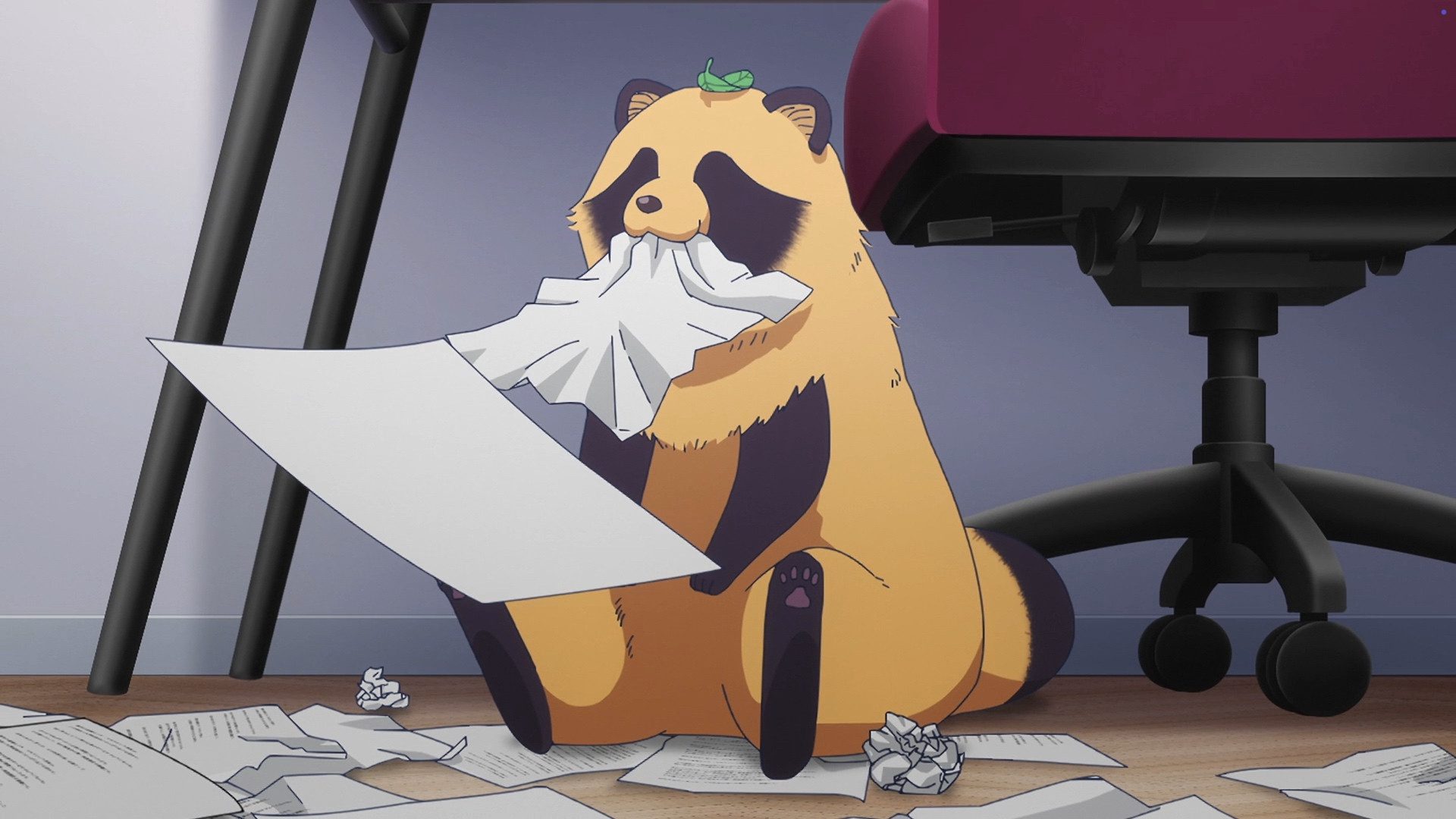
What’s it about? On a rainy walk home, Fuji encounters a dog(?) abandoned on the side of the road. She’s unsure if she can take in a pet, but the dog(?) sweetens the deal by offering her an umbrella too. But is this really a dog? Most dogs don’t communicate with their owners using cue cards. Everyone around them seems to know something’s up, but, hey, are you really going to argue with such a talented little dog?
If you asked if there’s a particularly profound moment that speaks to the brilliance of With You and the Rain, we’d be hard pressed to find that specific moment. Each episode is like sitting in your room looking out the window on a rainy autumn day. There’s no moment that compels you to argue this is the finest piece of media we’ve ever seen, but there’s something soothing and relaxing, just as it is staring out your window and remembering there’s birds, wind, and trees out there.
But as ephemeral that feeling is, With You’s writing is tight by being consistent and keeping focus on the two stars of the show: Fuji and the tanuki.
Doing this allows for an overarching story to play out even as it maintains its slice-of-life vignettes. Fuji and the tanuki meet a neighbor, Fuji hangs out with her friends from high school. The tanuki meets another pet he kinda hates. Fuji does a zoom call. It all works to not only create “relatable” moments slice-of-life shows so-often evoke, but also ultimately builds a portrait of the enigmatic protagonist who decided to take in a tanuki left in the rain. And you know the story succeeded in building that character, because the cour ends where it began as it recontextualizes Fuji’s first meeting with the creature. While it’s not verbatim, the retelling only works because of the holistic experience having watched the show, to understand who Fuji is as a character.
Moreover, so many stories, in want of building emotion for its finale, often invents a climatic conflict, but the climax of the show is just as mundane. Realistically taking place in the penultimate episode as the finale instead recontextualizes the premier, the emotional climax doesn’t take a needless aside to beg questions for melodrama or grossly disrupt the status quo. Instead it ends with reflection and affirmation between Fuji and the tanuki.
When media is becoming increasingly disposable, describing a show as easy to watch often feels dismissive. There’s no stakes and it’s all vibes. Yet With You manages to make that all happen without being totally garbage for people who are sitting there and paying attention. It doesn’t insult your intelligence by acting like you weren’t paying attention for the last 10 minutes. It all made me hone in for the end to leave things off on a positive note.
And like, ok, the tanuki is a real gremlin and he’s amazing. I love him. That’s really important to note too.
Source link
cats] , , #Anime #Feminist #Recommendations #Summer, #Anime #Feminist #Recommendations #Summer, 1761484470, anime-feminist-recommendations-of-summer-2025